(360) 230-9943
Blogs
Blog List
- When Your Relationship Starts Feeling Like a Business Partnership
- Foreplay Does Not Happen Only in the Bedroom
- When Defensiveness Takes Over a Relationship
- Surviving an Affair: Can a Relationship Recover After Betrayal?
- Exes, Boundaries, and Protecting the Relationship
- The Quiet Loneliness That Can Exist Inside Relationships
- When One Person Wants to Save the Relationship and the Other Isn’t Sure
- Why We Keep Missing Each Other: The Connection Between Emotional and Physical Intimacy
- Proximity Does Not Equal Presence
| |
When Your Relationship Starts Feeling Like a Business Partnership
By James Gallegos, LMFT

Many couples don’t notice the shift at first.
Life becomes busy. Responsibilities grow. Careers, children, finances, schedules, obligations, aging parents, household tasks — all of it slowly begins demanding attention. Conversations become more logistical than emotional. Communication becomes centered around calendars, errands, bills, and responsibilities.
Eventually, some couples realize something unsettling:
They function well together.
But they no longer feel deeply connected to each other.
The relationship begins to feel less like a partnership built on intimacy and more like a business arrangement built on efficiency.
| |
How Couples Slowly Drift Into This Dynamic
This rarely happens because two people stop loving each other.
More often, it happens because life slowly trains couples to prioritize management over connection.
At first, the shift can seem harmless:
- conversations become shorter
- affection becomes less frequent
- emotional check-ins become less natural
- stress and exhaustion replace curiosity and playfulness
Over time, couples may begin interacting mostly around:
- schedules
- parenting
- finances
- responsibilities
- problem-solving
The relationship becomes operational.
And while functioning together is important, relationships usually cannot thrive on logistics alone.
| |
The Quiet Loneliness Inside Functional Relationships
One of the more painful aspects of this dynamic is that from the outside, the relationship may appear stable.
There may not be constant fighting.
There may not be major betrayals.
The couple may even work very well as a team.
But internally, one or both partners may begin feeling:
- emotionally unseen
- disconnected
- lonely
- unimportant
- emotionally cautious
- resigned
Sometimes couples describe this feeling by saying:
“We feel more like roommates.”
Or:
“We’re great at running life together, but we don’t really feel close anymore.”
This kind of emotional distance often develops gradually enough that couples adapt to it without fully realizing how much closeness has been lost.
| |
Why Emotional Connection Often Gets Replaced by Efficiency
In long-term relationships, efficiency can quietly become the goal.
Couples become focused on:
- getting through the week
- reducing conflict
- managing stress
- staying productive
- keeping life organized
But emotional intimacy requires something very different.
It requires:
- slowing down
- emotional availability
- vulnerability
- curiosity
- responsiveness
- intentional connection
And those things are often the first casualties of chronic stress and emotional fatigue.
Many couples are not intentionally neglecting the relationship.
They are simply overwhelmed and emotionally depleted.
| |
Sometimes the Problem Isn’t Communication
Couples often assume the issue is communication itself.
But many times, the deeper issue is emotional safety and emotional accessibility.
Partners may stop bringing up deeper feelings because:
- conversations become defensive
- vulnerability feels risky
- attempts at connection feel ignored
- conflict feels repetitive
- emotional bids no longer feel welcomed
Over time, people begin protecting themselves by talking less honestly, needing less openly, or emotionally withdrawing altogether.
The relationship can slowly become more polite than intimate.
| |
Reconnection Usually Starts Small
One misconception many couples have is that reconnection requires dramatic changes.
Often, it starts much smaller than that.
Reconnection may begin with:
- slowing conversations down
- becoming more emotionally responsive
- expressing appreciation again
- learning to discuss conflict differently
- creating small moments of intentional connection
- becoming emotionally curious about each other again
For many couples, the goal is not to “go back” to the beginning of the relationship.
It is to build a more intentional connection within the realities of the life they have now.
| |
Long-Term Relationships Require Ongoing Attention
Strong relationships are not usually built solely on compatibility.
They are built on continued emotional investment over time.
Even loving couples can slowly drift into patterns where:
- emotional connection becomes secondary
- conversations become transactional
- closeness becomes assumed instead of nurtured
The good news is that many couples begin improving once they better understand the cycle they’ve fallen into — rather than simply blaming each other for the distance.
Sometimes the deeper work in a relationship isn’t saying more.
It’s making it safer for both partners to say more.
| |
If your relationship has started feeling more functional than connected, you are not alone. Many couples reach a point where the demands of life slowly overshadow the emotional side of the relationship.
I offer couples counseling for partners looking to rebuild emotional connection, improve communication, and better understand the patterns that keep them feeling distant from one another.
If you’d like to learn more, you’re welcome to reach out to schedule a free consultation.
| |
Foreplay Does Not Happen Only in the Bedroom
By James Gallegos, LMFT

Many couples think of foreplay as something that begins moments before sex.
But in long-term relationships, foreplay often starts much earlier than that.
It can begin in small moments throughout the day:
- feeling emotionally understood
- being spoken to with warmth
- affectionate touch without pressure
- feeling prioritized
- laughing together
- experiencing emotional safety
- feeling desired outside of sexual moments
For many couples, sexual intimacy does not exist separately from the emotional climate of the relationship. The quality of connection outside the bedroom often shapes the quality of connection inside it.
| |
Emotional Intimacy and Sexual Intimacy Are Often Deeply Connected
Over time, many relationships slowly become dominated by logistics:
- work
- parenting
- schedules
- responsibilities
- stress
- exhaustion
Couples begin functioning well together, but emotionally, they may start drifting apart.
Conversations become shorter.
Physical affection becomes less frequent.
Touch becomes more functional than affectionate.
Sometimes the only physical contact left in the relationship occurs when one partner is hoping sex will happen.
And for many couples, that creates pressure rather than closeness.
Non-sexual affection often plays a crucial role in helping partners feel emotionally connected and physically safe with each other.
Things like:
- hugging
- sitting close together
- holding hands
- affectionate touch
- kissing without expectation
- emotional attentiveness
These moments communicate:
“I want connection with you, not just access to you.”
Without them, physical intimacy can slowly begin feeling emotionally disconnected, transactional, or pressured.
| |
When Couples Stop Feeling Emotionally Close
One of the more common patterns couples experience is this:
The less emotionally connected they feel, the less natural physical intimacy becomes.
And then the reduction in physical intimacy creates even more emotional distance.
Over time, couples can become caught in a painful cycle where:
- one partner feels rejected
- the other feels pressured
- resentment builds
- touch becomes loaded with meaning
- both partners begin protecting themselves emotionally
Eventually, some couples stop initiating altogether because the experience has become too emotionally complicated.
What once felt playful and connecting can begin feeling tense, vulnerable, or uncertain.
| |
Meaningful Sex Usually Requires More Than Physical Attraction
Many couples assume declining intimacy means:
- attraction is gone
- chemistry is gone
- something is “wrong”
But often, the issue is not a lack of attraction.
It is a lack of emotional connection, emotional safety, or emotional presence.
In long-term relationships, meaningful sexual intimacy often depends heavily on:
- emotional responsiveness
- trust
- warmth
- affection
- attentiveness
- feeling emotionally valued
People generally struggle to feel open, relaxed, and connected physically when they feel emotionally distant, criticized, unseen, or emotionally alone.
For many couples, the issue is less about technique and more about the emotional atmosphere surrounding the relationship itself.
| |
Foreplay Is Often Built During Ordinary Moments
In healthy long-term relationships, intimacy is often built gradually throughout everyday life.
Sometimes foreplay looks like:
- checking in emotionally after a hard day
- small affectionate gestures
- speaking kindly during stress
- feeling emotionally chosen
- helping a partner feel less alone
- staying connected during conflict instead of becoming hostile or withdrawn
These moments may not seem overtly sexual, but they often create the emotional closeness that allows sexual intimacy to feel natural rather than forced.
Many partners are not simply asking for sex.
They are asking to feel connected, desired, safe, important, and emotionally close.
| |
Rebuilding Intimacy Often Starts Outside the Bedroom
When couples become stuck around sex, they often focus only on frequency.
But sometimes the deeper work begins by rebuilding:
- emotional intimacy
- friendship
- affection
- responsiveness
- trust
- emotional safety
For some couples, this means learning how to reconnect without immediately making every touch lead toward sex.
That can help reduce pressure and rebuild comfort, warmth, and closeness again.
The goal is not perfection.
The goal is helping the relationship feel emotionally alive again.
| |
Long-term relationships naturally go through seasons where intimacy changes. But emotional distance and physical distance often reinforce each other in ways couples do not fully recognize until the relationship begins feeling lonely, tense, or disconnected.
Many couples benefit from having a space to slow these patterns down, better understand each other, and rebuild both emotional and physical closeness in a healthier way.
I offer couples counseling for partners looking to improve emotional connection, communication, intimacy, and relationship satisfaction.
If you’d like to learn more, you’re welcome to reach out to schedule a free consultation.
| |
When Defensiveness Takes Over a Relationship
By James Gallegos, LMFT

Defensiveness is one of the most common patterns couples fall into — and one of the most damaging over time.
Most people do not become defensive because they want conflict.
They become defensive because they feel criticized, misunderstood, blamed, inadequate, controlled, or emotionally unsafe.
But even when defensiveness is understandable, it often creates a painful cycle inside relationships:
- one partner feels unheard
- the other feels attacked
- conversations escalate quickly
- both people become increasingly reactive
- emotional closeness slowly deteriorates
Over time, couples may stop feeling like they are working together and start feeling like they are protecting themselves from each other.
| |
Defensiveness Is Often Protection
Many people think defensiveness simply means refusing to take accountability.
Sometimes that is true. But more often, defensiveness is an attempt to protect against uncomfortable emotions:
- shame
- failure
- inadequacy
- rejection
- disappointment
- fear of not being enough
When a partner feels emotionally cornered, even mild feedback can begin feeling threatening.
So instead of hearing:
“I miss feeling close to you.”
They may internally hear:
“You’re failing me.”
And once someone feels emotionally threatened, the nervous system often shifts into self-protection rather than openness.
That is when conversations begin turning into:
- explanations
- counterattacks
- excuses
- blame shifting
- emotional withdrawal
- shutting down
- arguing over details instead of feelings
The original issue often gets completely lost.
| |
The Problem With Chronic Defensiveness
The difficulty is that defensiveness rarely makes the other partner feel safer or more understood.
Instead, it often leaves them feeling:
- dismissed
- emotionally alone
- blamed for bringing concerns up
- reluctant to communicate honestly
Over time, some partners stop expressing needs altogether because every conversation feels exhausting or circular.
Others begin escalating their frustration in an attempt to finally feel heard.
This can create a cycle where:
- one partner becomes more critical or pursuing
- the other becomes more defensive or withdrawn
- both people feel increasingly misunderstood
Eventually, couples can become trapped in repetitive arguments that never truly resolve.
| |
Defensiveness Slowly Erodes Emotional Safety
Healthy relationships require the ability to influence each other emotionally.
Not perfectly.
But consistently enough that both people feel:
- heard
- considered
- emotionally important
When defensiveness becomes chronic, couples often lose the ability to have vulnerable conversations safely.Partners may begin:
- walking on eggshells
- avoiding important topics
- suppressing feelings
- assuming negative intent
- emotionally disengaging
The relationship can start feeling emotionally tense even during ordinary interactions.
And often, the deeper issue is not the topic being argued about.
It is the growing sense that emotional honesty no longer feels safe.
| |
Accountability Is Not the Same as Shame
One of the biggest struggles defensive partners often face is confusing accountability with personal failure.
In healthy relationships, accountability is not meant to establish who is “bad” or “wrong.”
It is meant to help partners better understand each other’s emotional experience.
Sometimes a partner does not need perfection.
They simply need to hear:
- “I understand why that hurt you.”
- “I can see how my behavior affected you.”
- “You’re not crazy for feeling that way.”
- “I don’t want us stuck in this cycle.”
Those moments often reduce conflict far more effectively than lengthy explanations or self-protection.
| |
Slowing the Cycle Down
Most defensive dynamics are not solved by forcing one partner to “stop being defensive.”
The deeper work is usually helping both partners understand:
- the emotional fears underneath the pattern
- how criticism and defensiveness reinforce each other
- how to communicate concerns without escalation
- how to remain emotionally engaged during discomfort
For many couples, this requires learning how to slow conversations down enough that vulnerability can begin replacing protection.
Because underneath many defensive relationships are two people who both want connection but no longer feel emotionally safe enough to reach for it effectively.
| |
Defensiveness Does Not Mean the Relationship Is Hopeless
Many couples become discouraged once defensiveness becomes entrenched.
But defensive patterns are often more changeable than they initially appear — especially once couples begin recognizing the cycle together instead of viewing each other as the enemy.
Relationships tend to improve when partners move away from:
- winning
- proving
- protecting
- blaming
And begin moving toward:
- understanding
- emotional responsibility
- responsiveness
- vulnerability
- emotional safety
That shift can profoundly change the emotional tone of a relationship over time.
| |
Many couples wait until conflict feels deeply repetitive and emotionally exhausting before seeking help. But defensive cycles often become more workable once both partners better understand the emotional dynamics underneath them.
I offer couples counseling for partners looking to improve communication, reduce conflict, rebuild emotional safety, and reconnect in healthier ways.
If you’d like to learn more, you’re welcome to reach out to schedule a free consultation.
| |
Surviving an Affair: Can a Relationship Recover After Betrayal?
By James Gallegos, LMFT

Few experiences shake a relationship more deeply than discovering an affair or betrayal.
For many couples, the moment of discovery feels emotionally disorienting. Anger, panic, grief, numbness, confusion, resentment, fear, and disbelief often arrive all at once. The relationship that once felt emotionally safe can suddenly feel uncertain and unstable.
Many couples describe this period as feeling like the ground beneath them has disappeared.
And while betrayal can profoundly damage a relationship, it does not always have to end it.
Some couples do eventually rebuild trust, reconnect emotionally, and create a healthier relationship than the one they had before. But recovery usually requires far more than simply “moving on” or trying to put the betrayal behind them.
Healing from betrayal is often a long and emotionally demanding process that asks both partners to confront difficult truths about themselves, the relationship, and the patterns that existed long before the affair occurred.
| |
Betrayal Is About More Than Physical Infidelity
In today’s world, betrayal can take many forms.
For some couples, it involves a physical affair. For others, the betrayal may center around:
- emotional affairs
- secretive online relationships
- hidden pornography use
- deceptive messaging
- dating apps
- repeated dishonesty
- secrecy that violates the emotional agreement of the relationship
At its core, betrayal is often less about a specific behavior and more about the loss of trust and emotional safety.
Many betrayed partners struggle not only with what happened, but with the painful realization that important parts of reality were hidden from them.
That loss of emotional security can deeply affect:
- trust
- self-esteem
- attachment
- emotional safety
- physical intimacy
- the ability to feel emotionally relaxed in the relationship
| |
Why Trust Cannot Be Rebuilt Through Words Alone
After betrayal, many couples desperately want reassurance.
The injured partner often wants answers, transparency, accountability, and some sense that the relationship is emotionally safe again.
At the same time, the partner who caused the betrayal may feel overwhelmed with shame, defensiveness, guilt, or fear that nothing they do will ever be enough.
This creates an emotionally volatile dynamic where both partners are often hurting intensely in different ways.
One of the more difficult realities about rebuilding trust is this:
Trust is rebuilt more through consistent behavior than through promises.
Over time, trust tends to grow through experiences of:
- honesty
- consistency
- emotional responsiveness
- accountability
- transparency
- reliability
- empathy
The betrayed partner is often watching less for perfect words and more for whether the relationship begins feeling emotionally dependable again.
| |
Accountability Requires More Than Apologies
For healing to occur, the partner who broke trust usually needs to move beyond simply apologizing and toward genuinely understanding the emotional impact of the betrayal.
Many injured partners are not only asking:
“Will this happen again?”
They are also asking:
“Do you truly understand what this did to me?”
Healing often requires:
- emotional accountability
- openness
- patience
- empathy
- willingness to answer difficult questions
- tolerance for the injured partner’s pain and uncertainty
At the same time, couples eventually also need to begin understanding the larger emotional dynamics inside the relationship itself.
This does not excuse the betrayal.
But many couples benefit from honestly exploring:
- emotional disconnection
- loneliness
- unresolved conflict
- avoidance
- loss of intimacy
- secrecy
- unaddressed resentment
- communication patterns that existed long before discovery
The goal is not blame shifting.
The goal is understanding the full relational picture so that new patterns can begin replacing old ones.
| |
Emotional Reconnection Often Happens Slowly
After betrayal, many couples want clarity quickly:
- Should we stay together?
- Can trust come back?
- Will the relationship ever feel normal again?
Unfortunately, healing rarely unfolds in a straight line.
There are often periods of:
- hope
- closeness
- anger
- grief
- setbacks
- emotional flooding
- uncertainty
This can feel discouraging for both partners.
But rebuilding a relationship after betrayal is usually less about “getting over it” and more about gradually creating a relationship that feels emotionally safer, more honest, and more connected than before.
For many couples, this means learning how to:
- communicate differently
- respond to conflict differently
- rebuild emotional intimacy
- create transparency
- reconnect physically and emotionally
- become emotionally accessible to each other again
| |
Some Relationships Do Heal
Not every relationship survives betrayal.
But many do.
And in some cases, couples emerge with:
- deeper honesty
- stronger emotional awareness
- improved communication
- healthier boundaries
- greater emotional intimacy
- a more intentional relationship
Recovery requires time, emotional work, and a willingness from both partners to face painful realities without becoming consumed by blame or hopelessness.
It is not easy work.
But many couples find that healing becomes more possible once they stop focusing only on the crisis itself and begin understanding the emotional patterns underneath it.
| |
Recovering from betrayal can feel overwhelming and emotionally exhausting, especially when couples feel stuck between anger, grief, confusion, and uncertainty about what happens next.
I offer counseling for couples and individuals working through affairs, betrayal, trust issues, emotional disconnection, and relationship repair.
If you’d like to learn more, you’re welcome to reach out to schedule a free consultation.
| |
Exes, Boundaries, and Protecting the Relationship
By James Gallegos, LMFT

Starting a new relationship after divorce or separation is often more emotionally complicated than couples expect.
Two people may genuinely love each other and still find themselves overwhelmed by stress, tension, and conflict once children, co-parenting responsibilities, and former partners become part of the relationship dynamic.
Blended families often require couples to navigate:
- divided responsibilities
- parenting differences
- loyalty conflicts
- scheduling stress
- unresolved hurt from previous relationships
- difficult communication with ex-partners
- emotional exhaustion
And over time, many couples realize they are spending so much energy managing outside stress that they have stopped protecting the relationship itself.
| |
Blended Families Often Carry Invisible Emotional Pressure
Many couples enter blended family relationships hoping for a fresh start.
But unlike first relationships, blended relationships are often formed alongside already existing emotional systems:
- children adjusting to change
- co-parenting dynamics
- financial stress
- former relational wounds
- ongoing communication with ex-partners
This can create chronic tension inside the new relationship even when both partners are trying their best.
One partner may feel caught between:
- supporting the new relationship
- •parenting responsibilities
- managing conflict with an ex
- protecting the emotional needs of their children
The other partner may begin feeling:
- secondary
- unsupported
- emotionally unprotected
- excluded from important decisions
- resentful about unclear boundaries
Over time, these emotional pressures can quietly erode connection and teamwork within the relationship.
| |
Sometimes the Real Problem Is Not the Ex
Many couples assume the primary issue is simply having a “difficult ex.”
And while hostile or boundary-crossing behavior can absolutely create stress, the deeper relational issue often becomes:
how the couple handles the stress together.
When partners stop feeling emotionally aligned around:
- boundaries
- communication
- parenting decisions
- prioritization
- emotional support
conflict inside the relationship often grows quickly.
The relationship can slowly begin organizing itself around managing outside chaos rather than nurturing emotional connection.
| |
The Importance of Unified Boundaries
One of the healthiest things couples in blended families can develop is a strong sense of emotional partnership.
That does not mean controlling the ex-partner or eliminating conflict entirely.
It means helping each other feel:
- supported
- protected
- considered
- emotionally prioritized
Healthy boundaries may involve:
- clearer communication expectations
- respectful co-parenting structure
- limits around intrusive behavior
- consistency with schedules and parenting agreements
- reducing unnecessary emotional entanglement with former relationships
But perhaps most importantly, boundaries require couples to stay emotionally connected to each other while navigating outside stress.
When partners become divided or reactive, resentment often grows quickly.
| |
Children Also Feel the Emotional Climate
Children in blended families are often highly sensitive to tension between households.
They may feel:
- loyalty conflicts
- confusion
- emotional pressure
- uncertainty about roles and expectations
When adults become emotionally reactive, hostile, or inconsistent, children often absorb more stress than parents realize.
That is why stability, emotional regulation, and respectful communication matter so deeply in blended family systems.
The goal is not perfection.
The goal is creating enough emotional consistency and safety that both the relationship and the family system can function more peacefully over time.
| |
Protecting the Relationship Matters
One of the most common mistakes couples make in blended families is unintentionally allowing stress management to replace emotional connection.
Conversations become centered around:
- logistics
- schedules
- parenting disagreements
- ex-partner conflict
- problem-solving
And eventually the relationship itself may begin feeling emotionally neglected.
Many couples need intentional time to reconnect outside of the constant demands surrounding the blended family system.
Because while co-parenting challenges are real, the long-term health of the relationship often depends on whether partners continue feeling emotionally close, emotionally supported, and emotionally united through the stress.
| |
Blended families can create unique emotional challenges that many couples feel unprepared for. Over time, outside conflict, unclear boundaries, and chronic stress can begin affecting emotional connection inside the relationship itself.
I offer couples counseling for partners working through blended family stress, communication struggles, conflict, emotional disconnection, and relationship repair.
If you’d like to learn more, you’re welcome to reach out to schedule a free consultation.
| |
The Quiet Loneliness That Can Exist Inside Relationships
By James Gallegos, LMFT

Loneliness is often thought of as something people experience when they are alone.
But one of the more painful forms of loneliness can happen while sitting right beside someone you love.
Many couples quietly reach a point where the relationship no longer feels emotionally close, even though life together continues moving forward. They still manage responsibilities, share routines, parent children, attend events, and function as a team in many ways.
Yet emotionally, something begins feeling absent.
Conversations become shorter.
Affection becomes less natural.
Emotional check-ins become infrequent.
The relationship slowly starts feeling more functional than connected.
And over time, some partners begin carrying a quiet sense of loneliness they struggle to fully explain.
| |
Emotional Distance Usually Happens Gradually
Most couples do not wake up one day suddenly disconnected.
More often, emotional distance develops slowly over time.
Life becomes busy:
- work
- parenting
- stress
- schedules
- financial pressure
- exhaustion
- unresolved conflict
Many couples become so focused on managing life that they unintentionally stop nurturing the emotional side of the relationship.
The relationship can slowly shift from:
“We feel emotionally connected.”
to:
“We work well together, but something feels missing.”
Because this shift tends to happen gradually, couples often adapt to the distance without fully realizing how emotionally disconnected they have become.
| |
Feeling Lonely in a Relationship Can Be Confusing
One of the reasons this experience feels so painful is because it often creates internal confusion.
People may think:
- “Why do I feel lonely when I’m not alone?”
- “Nothing is terribly wrong, so why do I feel disconnected?”
- “Why do I miss my partner even when we’re together?”
Many couples assume loneliness only exists in relationships with constant fighting or obvious dysfunction.
But emotional loneliness often develops quietly inside otherwise stable relationships.
Sometimes the relationship still appears healthy from the outside:
- no major betrayal
- no explosive conflict
- no dramatic instability
Yet internally, one or both partners may feel:
- emotionally unseen
- emotionally unsupported
- disconnected
- emotionally cautious
- emotionally neglected
- resigned
Over time, this emotional absence can slowly affect nearly every aspect of the relationship.
| |
Emotional Safety and Emotional Accessibility Matter
In many disconnected relationships, the issue is not simply communication quantity.
Couples may still talk regularly about:
- schedules
- responsibilities
- parenting
- logistics
- finances
But emotional communication often becomes much more limited.
Partners may stop sharing:
- vulnerabilities
- fears
- emotional needs
- disappointments
- insecurities
- desires for connection
Sometimes this happens because previous attempts at emotional closeness felt:
- dismissed
- defensive
- misunderstood
- emotionally unsafe
- ignored
Over time, people often begin protecting themselves emotionally by needing less openly and revealing less vulnerably.
The relationship can slowly become emotionally careful instead of emotionally connected.
| |
Physical Intimacy Often Changes Too
Emotional loneliness inside relationships frequently affects physical intimacy as well.
Many couples notice:
- less affection
- less touch
- less playfulness
- less emotional warmth
- less meaningful sexual connection
For some couples, physical intimacy becomes infrequent.
For others, sex may still happen, but emotional closeness during intimacy feels diminished.
This can create an even deeper sense of loneliness because partners may no longer feel emotionally chosen, desired, or connected in the ways they once did.
| |
Reconnection Usually Begins With Small Moments
Many couples assume that reconnecting requires dramatic changes.
Often, it begins much more quietly than that.
Reconnection tends to grow through small experiences of emotional responsiveness:
- feeling listened to
- feeling emotionally prioritized
- sharing more honestly
- becoming curious about each other again
- spending intentional time together
- expressing appreciation
- rebuilding emotional safety
- turning toward each other emotionally during stress instead of away
These moments may seem small, but over time they help relationships feel emotionally alive again.
Because in long-term relationships, connection is usually not maintained automatically.
It requires ongoing emotional attention.
| |
The Loneliness Does Not Always Mean the Relationship Is Broken
Many couples become discouraged once emotional distance settles into the relationship.
But emotional disconnection is often more workable than couples initially believe.
The important thing is recognizing the pattern before resentment, hopelessness, or emotional resignation become deeply entrenched.
Often the deeper work is not simply learning how to “communicate better.”
It is helping both partners feel emotionally safe enough to reconnect honestly again.
Sometimes the most painful part of loneliness inside a relationship is not the absence of love.
It is the absence of emotional closeness.
And many couples find that closeness can gradually be rebuilt once the relationship becomes a safer place for vulnerability, responsiveness, and emotional connection again.
| |
Many couples quietly struggle with emotional disconnection for years before reaching out for support. Over time, loneliness inside a relationship can begin affecting communication, intimacy, trust, and overall relationship satisfaction.
I offer couples counseling for partners looking to rebuild emotional connection, improve communication, and better understand the patterns that keep them feeling distant from one another.
If you’d like to learn more, you’re welcome to reach out to schedule a free consultation.
| |
When One Person Wants to Save the Relationship and the Other Isn’t Sure
By James Gallegos, LMFT

“I want to keep trying.”
“I don’t know if I have anything left.”
These are some of the most painful words a couple can hear.
In many struggling relationships, both partners agree that something needs to change. But sometimes they arrive in my office in very different places emotionally.
One partner still believes the relationship can be repaired.
The other feels exhausted, discouraged, or uncertain whether they even want to continue.
If this describes your relationship, you are not alone.
| |
The Problem Isn’t Always Communication
Many couples assume they simply need to learn better communication skills.
While communication is certainly important, it isn’t always the first issue that needs attention.
Imagine trying to remodel a house before deciding whether you’re going to live in it.
That is often what happens when couples begin traditional marriage counseling while one partner is already questioning whether they want to stay.
Teaching communication techniques makes little sense if one person hasn’t yet decided whether they want to invest in rebuilding the relationship.
Before we can work on the relationship, we often need to answer a more fundamental question:
“Are we both willing to try?”
| |
The Leaning-In and Leaning-Out Dynamic
One of the most common patterns I see is what therapists sometimes call the leaning-in and leaning-out relationship.
The leaning-in partner often says things like:
- “I’ll do whatever it takes.”
- “Please don’t give up on us.”
- “We can fix this.”
The leaning-out partner often sounds different:
- “I don’t know if I can do this anymore.”
- “I’ve been unhappy for years.”
- “I’m tired.”
- "I just don’t know.”
Neither person is necessarily wrong.
They are simply standing in different emotional places.
Unfortunately, these differences often create even more distance.
The more one partner pursues, the more the other withdraws.
The more desperate one person becomes, the more trapped the other feels.
Soon, every conversation revolves around the future of the relationship rather than understanding what brought them here.
| |
Slowing Down Can Be the Most Helpful Step
When emotions are running high, many couples feel pressured to make immediate decisions.
Should we separate?
Should we stay together?
Should we file for divorce?
Should we keep trying?
Those decisions deserve thoughtful consideration rather than emotional reactions.
Sometimes the healthiest next step is not making a decision immediately—it is creating enough space to understand why each partner has arrived where they are.
That is the purpose of Discernment Counseling.
Instead of rushing toward reconciliation or separation, we slow the process down and explore questions that often haven’t been asked honestly.
- What happened to our relationship?
- What have we already tried?
- What role have I played?
- What would need to change for me to stay?
- What fears am I carrying if we separate?
These conversations are not about assigning blame.
They are about gaining clarity.
| |
Three Possible Outcomes
One of the things I appreciate most about Discernment Counseling is that it doesn’t pressure couples toward a particular outcome.
Instead, couples generally arrive at one of three paths.
Some decide to continue their relationship as it currently exists.
Some decide that separation is the healthiest decision.
Others realize there is enough hope, willingness, and commitment to begin the difficult work of rebuilding the relationship through couples therapy.
Whatever path is chosen, the goal is that it is made thoughtfully, intentionally, and with fewer regrets.
| |
There Is Hope—Even If You Don’t Yet Know the Answer
Many couples contact me feeling embarrassed that they have reached this point.
They wonder whether it’s “too late.”
The truth is that uncertainty does not always mean the relationship is over.
Sometimes uncertainty is simply an invitation to pause, reflect, and understand your relationship more deeply before making life-changing decisions.
Whether you ultimately choose to repair your relationship or move in a different direction, clarity is a gift.
If you and your partner find yourselves standing in different places—one leaning in and one leaning out—you don’t have to navigate that uncertainty alone.
Discernment Counseling offers a respectful, structured process to help both partners better understand themselves, each other, and the path that lies ahead.
| |
Why We Keep Missing Each Other: The Connection Between Emotional and Physical Intimacy
By James Gallegos, LMFT

One of the most common conversations I hear in couples therapy sounds something like this: One partner says, “If we had sex more often, I would feel closer to you.” The other responds, “If I felt closer to you, I would want to have sex more often.”
Interestingly, both may be telling the truth.
They are often describing two different pathways toward the same thing: feeling loved, wanted, secure, and connected to their partner. Unfortunately, when couples don't understand this difference, emotional intimacy and physical intimacy can become locked in a frustrating cycle in which each person is waiting for the other to provide the kind of connection they need first.
| |
Two Different Pathways to Connection
While every couple is different, I frequently see a pattern in my work in which the husband experiences physical intimacy as an important pathway toward emotional closeness, while the wife experiences emotional closeness as an important pathway toward physical intimacy.
This certainly isn't true of every couple. I work with women who deeply long for more physical intimacy and men who are hungry for greater emotional connection. The important issue isn't gender as much as recognizing that partners may experience the road to intimacy very differently.
For one partner, physical affection and sexual intimacy may create a powerful sense of being wanted, accepted, and emotionally connected. For the other, sexual desire may be much more likely to emerge after feeling emotionally safe, understood, appreciated, and connected.
Neither pathway is wrong. The difficulty begins when each person assumes that their pathway should also make sense to their partner.
| |
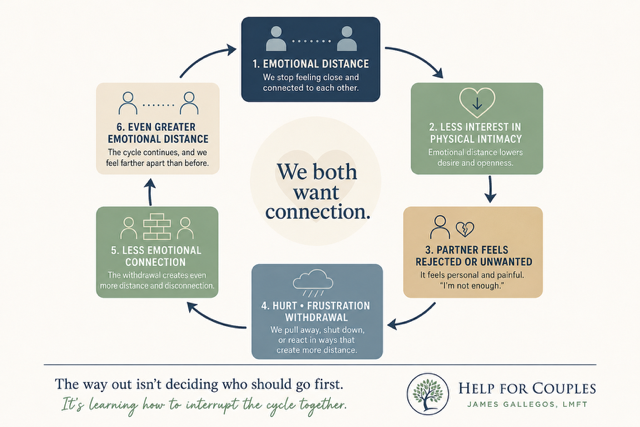
When Different Needs Become a Cycle
Over time, these differences can create a painful pattern.
A husband may reach for physical closeness because that is one of the primary ways he experiences connection with his wife. If she doesn't feel emotionally connected at that moment, she may pull away or decline. He experiences her response not simply as a lack of interest in sex, but as rejection. He may become hurt, frustrated, or emotionally withdrawn.
His withdrawal then reinforces exactly what she was already experiencing: emotional distance. She may think, “You only seem interested in being close to me when you want sex.” As she feels less emotionally connected, her desire for physical intimacy decreases even further.
Now both people are hurting, but for different reasons.
He may be thinking, “If she really loved me, wouldn't she want me?”
She may be thinking, “If he really loved me, wouldn't he care about how disconnected I feel?”
The more this cycle repeats, the easier it becomes for both partners to believe that the other simply doesn't care.
| |
Eventually, It Isn't Really About Sex
This is one of the more important things I try to help couples understand. What begins as a disagreement about the frequency of sex often becomes something much deeper.
For the partner wanting more physical intimacy, the pain may eventually sound more like, “I don't feel wanted by you anymore.” For the partner wanting greater emotional intimacy, the pain may sound more like, “I don't feel known or important to you anymore.”
Those are very different conversations from simply arguing about how often a couple has sex.
Underneath both experiences is often the same fundamental question: Do I still matter to you?
Once couples can begin talking about that question rather than fighting over the surface issue, the conversation often changes.
| |
Emotional Intimacy Is More Than Talking About Feelings
When couples hear the phrase “emotional intimacy,” they sometimes imagine that it means sitting down for long, serious conversations about their feelings. While those conversations can certainly matter, emotional intimacy is usually built in much smaller moments.
It happens when your partner tells you about a difficult day and you listen instead of immediately offering a solution. It happens when you notice that something seems off and ask about it. It happens when you put down your phone, follow through on something you promised, express appreciation, laugh together, or respond with curiosity instead of defensiveness.
These ordinary interactions communicate something important: “I see you. You matter to me. I'm interested in what is happening inside of you.”
Repeated over time, these moments create emotional safety. For many people, that sense of safety is an important part of experiencing sexual desire.
| |
Physical Intimacy Is More Than Sex
The same is true of physical intimacy. When a couple's sexual relationship is struggling, physical touch can begin to feel loaded. A hug may be interpreted as an attempt to initiate sex, while the partner initiating the hug may simply be longing for reassurance and affection.
Physical intimacy includes holding hands, sitting close together, kissing, cuddling, touching someone's arm as you walk past, or lingering in a hug for a few extra seconds. These small moments can communicate warmth, affection, reassurance, and the simple message, “I still choose you.”
For some people, physical affection is one of the strongest ways they experience emotional connection. When it disappears completely, they may experience the relationship as emotionally distant even when their partner doesn't realize anything has changed.
| |
The Problem With Waiting for Your Partner to Go First
This is where many couples become stuck. One person is essentially saying, “When you become more emotionally available, I'll become more physically available.” The other is saying, “When you become more physically available, I'll feel safe enough to become more emotionally available.”
Both positions make sense individually. Together, however, they create a stalemate.
Each person is waiting for evidence that it is safe to move toward the other.
The way out usually isn't deciding whose need is more legitimate or determining who should go first. It begins when both partners recognize that they are participating in a cycle that is hurting them both.
Instead of asking, “Why aren't you giving me what I need?” a much more useful question becomes, “What happens inside of you that makes it difficult to move toward me?”
That question invites curiosity rather than defensiveness.
| |
Rebuilding the Bridge From Both Sides
Repair usually doesn't begin with dramatic changes. It begins with small movements toward one another.
The partner longing for emotional intimacy may need to recognize that physical affection isn't necessarily a demand for sex. It may be the other person's way of asking, “Are we okay? Do you still want me? Are we still connected?”
The partner longing for physical intimacy may need to understand that emotional connection isn't simply another hoop to jump through before sex can happen. Feeling listened to, valued, respected, and emotionally safe may actually be part of how desire develops for their partner.
When each person begins understanding the meaning underneath the other's need, the conflict becomes less about who is right and more about how they can begin meeting in the middle.
| |
A Different Conversation About Intimacy
If you and your partner are caught in this pattern, try setting aside the question of frequency for a moment. Instead, ask each other:
“When do you feel closest to me?”
“What helps you feel wanted by me?”
“What makes you pull away?”
“What helps you feel safe enough to move toward me?”
Listen to the answers without correcting them, defending yourself, or explaining why your partner shouldn't feel that way. The purpose isn't to solve everything in one conversation. The purpose is to understand your partner's experience a little better than you did before.
Because emotional intimacy and physical intimacy aren't competitors. In healthy relationships, they strengthen one another.
Emotional closeness can create greater openness to physical intimacy. Physical affection can reinforce emotional connection. Both can communicate the same essential message: “You matter to me, and I still want to be close to you.”
Sometimes couples simply need help recognizing that they have been standing on opposite sides of the same bridge, each waiting for the other to cross first.
The work of reconnection begins when they start building toward one another.
| |
Proximity Does Not Equal Presence
By James Gallegos, LMFT
The problem occurs when managing the relationship gradually replaces experiencing the relationship.

Many couples come to therapy frustrated by something they have difficulty explaining. They spend plenty of time together. They live in the same house, sleep in the same bed, eat dinner at the same table, raise children together, run errands together, and sit next to each other on the couch at the end of the day.
And yet, one or both of them feels incredibly alone.
Sometimes when I ask about the amount of time they spend together, one partner will respond, “But we’re together all the time.” That may be completely true. The problem is that being together and feeling connected are not necessarily the same thing.
You can share a home with someone and still feel emotionally miles apart.
Proximity is about being in the same place. Presence is about being in each other’s world.
| |
The Difference Between Proximity and Presence
Proximity is relatively easy to measure. We know how much time we spend around our partner. We know whether we ate dinner together, watched television together, went somewhere together, or spent the weekend in the same house.
Presence is harder to measure because it describes the quality of what happens during those moments.
Presence means that when your partner is talking, some part of you is genuinely interested in what they are saying. It means noticing their mood, asking questions, making eye contact, laughing together, touching one another, or simply being emotionally available.
It means that your partner experiences you not merely as someone who is physically nearby, but as someone who is actually with them.
That distinction matters.
Two people can spend an entire evening together while barely interacting. They can watch television while simultaneously scrolling through their phones. They can talk primarily about schedules, children, bills, groceries, appointments, and what needs to happen tomorrow.
None of those things are inherently problematic. They are simply the business of running a life together.
The problem occurs when managing the relationship gradually replaces experiencing the relationship.
| |
How Couples Slowly Become Disconnected
Most couples don’t wake up one morning and suddenly decide to stop being emotionally connected. Disconnection usually happens much more quietly.
Life gets busy. Careers become demanding. Children require attention. Stress increases. Phones and screens become easy distractions. Conversations become shorter and increasingly focused on logistics.
Eventually, partners stop asking some of the questions they once naturally asked.
“How are you doing?”
“What’s been on your mind lately?”
“What are you excited about?”
“What’s been hard?”
“What do you need from me?”
Instead, conversations become almost entirely functional: Who is picking up the kids? What time is the appointment? Did you pay that bill? What do we need from the grocery store?
Without realizing it, two people who once spent hours learning about each other can slowly become very efficient roommates.
They may function together remarkably well while feeling increasingly disconnected from one another.
| |
When “We Spend Plenty of Time Together” Becomes the Problem
This can create an especially frustrating dynamic when one partner begins asking for more connection.
The other partner may genuinely feel confused.
“What do you mean? We just spent the whole weekend together.”
From their perspective, the amount of time together should demonstrate closeness. From their partner’s perspective, however, the issue was never the number of hours spent in the same room.
The issue was what happened—or didn’t happen—during those hours.
This is where couples can begin arguing about the wrong thing. One partner tries to prove how much time they spend together while the other tries to explain why that time doesn’t feel emotionally meaningful.
Both may be describing their experience accurately.
They are simply measuring connection differently.
| |
Loneliness Inside a Relationship
There is a particular kind of loneliness that can occur when the person you most want to feel connected to is sitting only a few feet away.
Physical distance at least makes sense. If your partner is traveling or living somewhere else temporarily, there is an obvious explanation for missing them.
Emotional distance is different.
Your partner may be sitting beside you, yet you don't feel seen by them. You may have things you want to say but have gradually stopped saying them because conversations seem to go nowhere. You may miss affection, curiosity, laughter, or simply the feeling that your partner is genuinely interested in you.
Over time, couples can begin protecting themselves from that disappointment. They stop reaching because reaching and not being met hurts.
Unfortunately, when both people begin doing this, the distance grows even larger.
| |
Presence Does Not Require a Three-Hour Heart-to-Heart
When I talk with couples about emotional presence, I sometimes worry that one partner hears, “Apparently we need to spend every evening talking about our feelings.”
Thankfully, that isn't what presence means.
Connection is usually built through much smaller moments.
Presence might mean putting your phone down when your partner tells you about their day. It might mean noticing that they seem quieter than usual and asking if something is bothering them. It could mean sitting together for ten minutes after dinner without a television or screen competing for your attention.
It might be reaching for your partner’s hand in the car, sharing something funny that happened during your day, giving them a genuine hug when they get home, or remembering to ask how something important went.
None of these moments are particularly dramatic.
That's precisely why they matter.
Strong relationships are rarely built through occasional grand gestures. They are built through hundreds of small moments in which two people communicate, “I'm here. I see you. You matter to me.”
| |
Attention Has Become One of Our Most Valuable Gifts
Modern relationships face a challenge that previous generations experienced very differently: our attention is almost constantly being requested by something.
Phones, email, social media, television, work, news, texts, notifications, and endless entertainment are always available. None of these things are necessarily bad. But they make it remarkably easy to be physically present while mentally somewhere else.
We can sit across from someone we love while giving our best attention to people and information that exist somewhere inside a screen.
Over time, that can send an unintended message to our partner: everything else seems more interesting than you.
Most of us would never consciously say that to someone we love. Yet relationships are shaped not only by what we intend to communicate, but also by what our partner repeatedly experiences.
Attention has become one of the most meaningful ways we can communicate love.

| |
Learning to Turn Toward Each Other Again
If you recognize your relationship in some of this, the solution isn't necessarily scheduling more date nights or finding more hours to spend together.
Sometimes couples already have plenty of proximity.
What they need is more presence.
Start small. Create moments during the day when screens are put away. Ask a question you don't already know the answer to. Listen without immediately solving the problem. Express appreciation for something you have stopped noticing. Sit closer. Make eye contact. Touch one another affectionately without expecting anything more.
Most importantly, become curious about your partner again.
One of the quiet dangers in long-term relationships is believing that because we have known someone for many years, we already know everything about them.
We don't.
People continue changing. Their fears change. Their hopes change. Their disappointments change. Their dreams change. The person sitting across from you today is not exactly the same person you married five, ten, twenty, or thirty years ago.
There is always more to learn.
| |
A Simple Question for Couples
If you want to experiment with this idea, ask each other one question:
“When do you feel that I am most present with you?”
Don't debate the answer. Don't explain what you intended. Don't defend yourself if your partner says something difficult.
Just listen.
Then ask:
“What is one small thing I could do that would help you feel more connected to me?”
The answer may be surprisingly simple.
| |
Being Together Is Not Enough
Most of us want to feel close to the person we love. But closeness doesn't happen automatically because two people share a home, a bed, a family, or a life.
Real intimacy requires something more.
It requires showing up.
It requires attention, curiosity, responsiveness, and the willingness to continue learning about the person beside you.
Because you can be inches away from someone and still feel completely alone.
Proximity is being in the same place. Presence is being in each other’s world.
And sometimes the most important change a couple can make isn't spending more time together.
It's becoming more present during the time they already have.